Thursday, February 16, 2012

Geographic Oddities: The Exclave

by Conroy

The Kentucky Bend
The Mississippi River flows in a meandering path across its wide, flat floodplain; appearing on the map like a slack garden hose, twisting and turning and practically looping back upon itself for the whole of its long and broad lower course below St. Louis. One the most notable bends occurs not too far south of where the Ohio River enters the main channel, and the south flow abruptly reverses and the river turns north and bends omega-like [1] in a counter-clockwise semicircle before returning to its southern course. In this location the river practically surrounds a little spread of land called the Kentucky Bend. What’s notable about this barely populated patch of fallow cotton fields is that is lies totally disconnected from the rest of the Bluegrass State. From here, a look across the Mississippi in any direction (east, north, and west) is of Missouri, and the only land access is from the south through Tennessee. The Kentucky Bend is an example of one of those geo-political oddities: the exclave [2].

There are examples of exclaves all over the world, and they tend to exist in locations where geography, history, and politics have combined to leave a portion of a state or nation where you wouldn’t expect it to be. The stories behind these exclaves are often interesting, and common sense may suggest that they not exist. Why isn’t the Kentucky Bend part of Tennessee, or even Missouri [3]?

First, what am I calling an exclave?  Definitions vary, but to me exclaves are geographic areas of one state or country that are physically separated from the bulk of their home state/country, requiring transit through (or over) another state/country, unless the separated place can be accessed via the open sea. If you can’t drive or walk or ride or fly or sail there without going through another place, it's an exclave. By this definition, Alaska isn’t an exclave of the United States. Sure it’s physically separated from the rest of the country, but planes and ships can transit between the “lower 48” and Alaska without going through Canadian territory. In the same vein, Hawaii, or any other island distant from the mainland, isn’t an exclave. 

Consider a few prominent examples (of dozens) of true exclaves from around the globe:

Straight Lines
A ninth-grade biology or Earth sciences student could tell you that nature doesn’t use straight lines; however, mankind loves them. Just compare man’s architecture to nature’s landscapes. As a consequence, our un-straight Earth, where even the flat horizon of a dead calm sea creates a circle, is divided into political units by straight lines drawn on flat maps. When this happens sometimes you end up with unexpected results. The U.S./Canadian border provides a great illustration of this point.

Point Roberts, Washington
Today it might seem strange that the rather tranquil boundary between the United States and Canada – the longest “unguarded” border in the world – was a place of longstanding and bitter dispute during the eighteenth and nineteenth centuries. A new and growing America vied with Britain for control of the Great Lakes, St. Lawrence River, and the vast interior west of the North American continent. These disputes were settled, peacefully for the most part, resulting in what is today the longest international land border in the world [4]. All of the disputes and agreements, treaties and tribunals decided matters on a macro scale, which produced no less than seven exclaves along the border:
  • Point Roberts, Washington on the Strait of Georgia and connected by land only to British Columbia.
  • Elm Point and Northwest Angle, Minnesota in the Northwest Angle of Minnesota but connected by land only to Manitoba.
  • Province Point and Alburg, Vermont on Lake Champlain but connected by land only to Quebec.
  • Saint Regis, Quebec on the St. Lawrence River but connected by land only to New York.
  • Campobello Island, New Brunswick which is only connected to land, via a bridge, to Maine.

A glance at the map shows that these places would more logically be part of the nations that they are physically attached to. But politics and history means that will never come to pass.

Straight lines similarly separate most U.S. states and Canadian provinces, creating exclaves in both countries. A few of note:
  • Knott’s Island, North Carolina which is actually connected by land to Virginia.
  • Eastern Shore of Virginia which is separated from the rest of the state by the lower Chesapeake Bay and connected by land to Maryland. However, its exclave status was largely eliminated when the Chesapeake Bay Bridge-Tunnel was completed in 1964, which now connects the eastern shore across the mouth of the Chesapeake Bay to Virginia Beach.
  • Lost Peninsula of Michigan, which is actually connected by land only to Ohio.
  • Cold Lake, Alberta where a spit of land near the town is actually connected by land only to Saskatchewan.

The March of History
Colorful West Berlin
There is more than orderly (if arbitrary) lines that create exclaves, unexpected historical developments are often a cause. Take Berlin after World War II. The city like the rest of Germany was partitioned between the Western Allies and the Soviet Union. Eventually the western controlled areas, West Berlin, emerged as a capitalist, democratic exclave surrounded by East Germany (and East Berlin). The vulnerability of this exclave was revealed when the Soviet Union, in one of the first overt acts of the Cold War, closed the land link between the city and West Germany in 1948. The city was then supported by a massive American-British airlift that lasted nine months until the Soviets reopened the ground links to the city. Later, West Berlin became a focal point for Germans fleeing the communist East. The exclave vanished in a good way when the two German nations reunified in 1990.


Friday, February 10, 2012

The Inferno of World War II

by Conroy

“War is prodigiously wasteful, because much of the effort made by rival combatants proves futile, and the price is paid in lives.”

“Among citizens of modern democracies to whom serious hardship and collective peril are unknown, the tribulations that hundreds of millions endured between 1939 and 1945 are almost beyond comprehension.”

“An average of 27,000 perished each day between September 1939 and August 1945 as a consequence of the global conflict.”

- Max Hastings, Inferno: The World at War,   1939-1945


It seems that seventy years after the events of World War II – the greatest calamity in human history – historians have gained a better understanding of the facts and effects of the conflict than anyone, be they leaders, generals, soldiers, civilians, or victims, had during the war or in the immediate post war period. Max Hastings is one of these historians and his many works on World War II stand out among the best histories of the conflict. To this list can be added his latest work, Inferno:The World at War, 1939-1945, an ambitious single-volume overview of the war.

Readers of this blog may remember an earlier post where I praised Hastings’ previous two books, Armageddon and Retribution, which respectively covered the final year of the war in Europe and the Pacific. As with those works, Hastings focus in Inferno is not on the Allied and Axis leadership, notable generals, or even the broad goals and war strategy. Instead, he provides a “bottom-up” approach that conveys the experience of war, what it was like to be a rifleman in battle, a civilian under aerial bombardment, or victim of pillage and rape (a ubiquitous civilian experience in many theaters of the war), to provide a few examples.

As Hastings notes it is impossible to present a blow-by-blow account of World War II, an immensely large and far-reaching subject, in 800-odd pages. In fact, a work ten times as long would be insufficient. Instead, he set out to provide an impression of events as they unfolded starting with the German invasion of Poland in September 1939 and ending with the Japanese surrender in Tokyo Bay six years later. He has succeeded. The quotations provided at the top of this post give a sense of the massive horror of the war, and indeed for a modern reader it’s very difficult to understand how such a large proportion of the world’s people could have endured under the stress of war for so long. No book can fully capture this reality, but Inferno does it as well as any. And it does this through largely new or never before used first-hand accounts, diaries, letters, etc. These sources add a gratifying freshness to the book.

Hastings also manages to provide some new insights that have been revealed through decades of studying World War II. There are no sacred cows in Hastings’ telling of the war and he expertly separates fact from myth and legend. This is useful and appropriate. Wars gather their own momentum and this was especially true for World War II. History (with a capital H) has largely identified the correct decisions from the terrible blunders, the necessary sacrifices from the useless wastes, the effective leaders from the incompetent, and the victims and criminals. But Hastings goes one step further, correctly assigning evil to those to which it belonged and separating it from the terrible logic of war, where horrible things happen to many people by all sides. There no moral equivocation with Hastings, only clarity.

I recommend this work highly, it presents the war as well as any single-volume history is likely to. Hastings book is both concise and comprehensive, but to better present Hastings’ mastery of the subject, I’ve provided a series of quotations and passages below that demonstrate two aspects of the book: the actual experience of the war – the bottom-up view, and the many blunders made by the Germany – the broad evolution of the War.

For me, the only real counter-factual worth pondering about World War II is this: Could Germany have won the war? That’s an important question mostly because such an outcome would have been catastrophic for most of Europe’s population and would have set subsequent history in a radically different direction (and thinking from a modern perspective, a very loathsome and bizarre direction). There is much debate about this issue, the forces arrayed against the Axis were enormously powerful, but surely the many and massive mistakes made by Germany (and Japan) contributed substantially to the Axis defeat.


Thursday, February 2, 2012

Warrior Tennis

by Conroy

Djokovic and Nadal weary after nearly six hours of play
Have we seen the limit of tennis? I mean, really, can the sport get any better? Much has already been written, deservedly, about the remarkable Australian Open final, won this past Sunday [1] by Novak Djokovic over Rafael Nadal; a nearly six hour match – six hours! – of energy-sapping intensity and dramatic competitive swings. This is just the latest, perhaps the ultimate culmination, in what is surely one of the glory times for the sport. We fans must count ourselves lucky that we get to watch three of the greatest players of all time – and yes, Djokovic has now entered that discussion – battle in so many riveting matches on tennis’ biggest stages.

One startling statistic communicates the hegemony that Roger Federer, Rafael Nadal, and now Novak Djokovic have established over tennis: Since the 2005 French Open – the last seven years – they have won 27 of 28 grand slam tournaments [2]. These three have and continue to demonstrate how far the bounds of excellence can be pushed. But along with the brilliance and athleticism come the compelling narratives that leave commentators (including this writer) searching for appropriate descriptions.

Tennis is often compared to other sports. Boxing is a favorite of the TV analyst types as players are described as landing “body blows” or going for the “knockout”, or engaged in a “heavyweight struggle.” This analogy seems fitting given the lonely one-on-one nature of tennis and more so as the sport has gotten more physical. Tennis is also compared to a mental struggle, a kind of hyper-kinetic chess, or as an ultimate test of men, a gladiator’s duel. Loftier still are comparisons of today’s top players to Greek mythical heroes, meeting in dramatic epical battles [3]. The fact that tennis matches are commonly compared to wars and battles [4] is a further expression of this perception. There may be hints of truth in these comparisons, but I think they miss something essential, something that can only be understood by examining the dominance and defeat of each man.

The Rise of Roger Federer
There will never be a perfect player, but by the end of 2003 the 22-year-old Roger Federer had become what many believed to be the next closest thing. Watching Federer in his prime, as David Foster Wallace famously wrote [5], was a religious experience. He was at once fast, graceful, and powerful. But these words don’t do him justice. He was more like the full embodiment of speed and grace and power. His shot-making was beautiful and brutally effective. His intelligence was obvious from how he constructed points, to the shots he chose to play, to his uncanny ability to anticipate and read opponents. He was a virtuoso; he owned every shot in the book and used them in ways no one had seen before. I’ll give you one of my favorite examples from the middle of the tense fifth set of the 2007 Wimbledon Final against Nadal.

Federer leads three games to two and is ahead in Nadal’s service game 0-15. Nadal, a lefty, hits a serve to Federer’s backhand, like he almost always does in the ad (left side) court, and Federer slices a short return into the middle of the court, forcing Nadal to come into the net. Nadal hits a forehand with heavy topspin deep into Federer’s backhand corner and follows this shot even closer to the net. Federer flicks a backhand to Nadal’s backhand side but above the Spaniard’s head. Nadal hits the only real shot available, a backhand crosscourt volley, and it’s good, bouncing low. But Federer has anticipated the shot and sprints along his baseline picking up the low ball and beating Nadal with a perfectly measured forehand pass. Now it’s 0-30 and Nadal again hits a serve to Federer’s backhand, up the “T” (middle) in the deuce (right side) court. Federer hits a neutral backhand return back down the center of the court to Nadal, who then hits a hard forehand to Federer’s forehand side. Nadal is anticipating a crosscourt forehand and has moved a couple of steps to his right. But instead Federer drills a deep, heavily top-spinned forehand into Nadal’s forehand corner. The ball is so well struck and such a surprise that even at a full gallop and stretch Nadal can’t reach it and it goes past him for another winner. Two points later and it’s 15-40. Nadal hits a body serve that Federer fights off with a floating forehand to Nadal’s backhand side. Nadal backs-up and hits a hard forehand deep the Federer’s backhand. Federer hits a hard backhand right back to Nadal who hits a backhand down the left (his right) sideline. Federer quickly scampers to the ball and hits a lofted backhand back toward Nadal but deep, just inside Nadal’s baseline. Nadal is forced to retreat and hits a neutral forehand to Federer’s forehand, where Federer, still on his backhand side of the court, hits a hard forehand near the left (Nadal’s right) sideline. This shot foreces Nadal to hit a crosscourt backhand which Federer anticipates and moves quickly to his right across to the deuce side of the court, easily tracking it down and responding with a crosscourt forehand. Nadal hits a hard backhand into the center of the court that Federer counters with a hard low slice backhand that barely clears the net and forces Nadal to scramble just to get to the ball. He’s forced to hit a short crosscourt forehand. Federer literally skips to his left and near his left sideline strikes a gorgeous forehand smack onto the left sideline past Nadal for a winner and the decisive break. These few critical points show Federer’s variety, intelligence, and wicked shot-making.

I can go on and on lauding his, well, magnificence, but seeing the real thing is better than reading about it, so check out these highlights. His game had (and still has) a genius, an originality and style and potency that can make you shout out loud in amazement while watching alone from your living room. I’ve noted his feats in previous posts, but from the end of 2003 through the end of 2007 he won 11 grand slams (of 16 played), won over 93% of his matches, and beat the other top players not named Nadal like a drum going 69-2 against Top 10 opponents – all feats unparalleled in tennis history. But if Federer was a tennis Superman there was definitely a kryptonite.

The Rise of Rafael Nadal
Federer made an interesting comment during the on-court interview following his 2007 Wimbledon win, stating that he was glad he won this match before Nadal won them all. In the moment it was probably intended as a compliment and as admittance that the match was a close-run thing. Indeed it was, and Federer’s remarks proved prescient, he hasn’t beaten Nadal in a grand slam match since (0-5).

Not long after Federer began dominating tennis there came the meteoric rise of Rafael Nadal, a tennis phenom. Here was the rare player who rose to the upper echelon of the game as a teenager, winning his first grand slam, the 2005 French Open, just after his 19th birthday; the first teen to do so since a 19-year-old Pete Sampras won the 1990 U.S. Open. His game was distinguished by its pure physicality. Nadal was blurry fast, he could run forever without tiring, his forehand was hit with tremendous power and an unprecedented amount of topspin. He was also metronomic-ally consistent hitting that forehand, and his strong two-handed backhand, shot after shot until, seemingly inevitably, his opponents made an error or grew impatient and forced (and missed) a risky shot. Add to that an unmatched competitive focus and determination – Nadal never takes a point off and never puts less than full effort into every exchange. This combination of skills and focus made him virtually unbeatable on clay where he set a never-to-be-beaten record of 81 consecutive match wins between 2005 and 2007. He beat Roger Federer in the French Open each year from 2005 through 2008, the last three in the final. The 2006 and 2007 final loses were Federer’s only defeats at a grand slam in those years. Why did Nadal give Federer, the perfect player, such trouble?


Thursday, January 26, 2012

Extreme Temperatures

by Conroy

Two of the most viewed posts on this blog are the “Perfect Climate” posts from last January (Part 1 here and Part 2 here). The whole point of those posts was to identify the “perfect” climate by reviewing the average – the normal – temperatures (daily mean, diurnal variation, seasonal differences, etc.) for hundreds of locations around the United States. During the extensive research for those writings, as I spent many many hours poring over temperature data, I became curious in the opposite, not the normal, but extreme temperatures.

In particular, I wondered what the high and low temperatures were across the entire country on any given day. How hot does the hottest place get in summer or the coldest in winter (and vice versa)? Surely it would be interesting to know this bit of trivia. It took a little searching, but fortunately, I found this exact information published by the National Weather Service (for populated places). Unfortunately, it’s published one day at a time with only the previous couple of days of national highs and lows listed. Also, for whatever reason, the NWS only publishes this information for the continental U.S., no Alaska or Hawaii (or for that matter, no Puerto Rico, Guam, American Samoa, etc.). Based on the lower 48’s extreme temperatures, Hawaii may occasionally have the nation’s warmest weather, but Alaska would almost certainly claim the coldest temperatures on most days (October to April anyway).

I patiently compiled the daily U.S. high and low temperatures (and the corresponding location) over the last year (January 22, 2011 to January 21, 2012). Some would call this obsessive or silly or strange, to which I can offer no really good rejoinder. But I did it, and crunching the numbers I found some interesting things to note (all temperature values in degrees Fahrenheit):

Extreme Temperature Facts

Bullhead City - likely on a hot day
Highest high.  On back-to-back summer afternoons, August 24 and 25, in Bullhead City, Arizona, the thermometer hit a suffocating 119 degrees. Bullhead City is located in the heart of the Mohave Desert along the Colorado River about 90 miles south of Las Vegas. The 119 degree temperature is actually seven degrees below Bullhead City’s record high of 126 degrees (126!). There were fourteen other days when the national high was at least 115 degrees, and all but one of those recordings was unsurprisingly taken in the desert southwest (Arizona and California).

Let me digress to discuss record high temperatures. The highest recorded temperature in North America, and the second highest ever recorded on Earth, is 134 degrees at Furnace Creek in Death Valley, California on July 10, 1913. That was nearly a century ago, and I have no idea who was reading that temperature, how the thermometer was calibrated, or whether it was even set-up right. Call me a skeptic, but 134 degrees in the shade seems rather high even for a record high temperature. Similarly, the highest ever recorded temperature on Earth – 136 degrees – was recorded in the Sahara at Aziziya, Libya on September 13, 1922. This 90-year-old recording is in dispute. If it is indeed inaccurate, what is the real highest temperature recorded in modern times?


Friday, January 20, 2012

The God Particle

by Conroy

Part of the 17-mile-long LHC particle accelerator
Late last year there was breathless excitement within the physics community as several experiments conducted by CERN [1] at the Large Hadron Collider [2] under Geneva seemed to hint at the presence of a fundamental, and as yet entirely theoretical, particle: the Higgs boson. What is this particle and why did these experiments so energize physicists? The short, simple answer is that the Higgs boson is the particle associated with the Higgs field, which is hypothesized to be a ubiquitous quantum “field”. Think of it as a force or condition throughout all of space that matter interacts with. It is theorized that Higgs bosons interact with other fundamental particles (electrons, quarks, etc.) to give them mass. If detected, the Higgs boson would further validate the so called Standard Model of particle physics, one of the core theories of how the universe (the fundamental particles and forces) is structured.

The news from CERN quickly spread to the general news media and Newsweek jumped to exclaim on a cover headline that the experiments hinted at, “The Meaning of the Universe.” Other publications picked up on the Higgs boson’s nickname as “the God particle”. These headlines and reactions create the impression that this discovery, if confirmed [3], would explain many of the remaining questions in theoretical physics and provide the answers to those eternal questions that have puzzled mankind for millennia. So would it?

The Profound Questions
The Higgs boson would explain why particular particles have a specific mass. Mass is a fundamental feature of matter and explaining how mass “works” would be a tremendous breakthrough. The results would also be important in the understanding of mass-less particles like photons. But the discovery would hardly answer the even more fundamental questions about the nature of the universe, such as:
  • What is the universe?
  • Where did it come from?
  • Why does it have the structure and forces that it does?
  • Is there anything outside of the universe?
  • What is the universe’s fate?
Let’s come back to these.

Everything to (Practically) Nothing
The Milky Way
There’s a terrific website – scaleofuniverse.com – that provides an interactive depiction of the size of the universe and everything in it. It’s a way to conceptualize just how inconceivably vast the totality of the universe is, and how absurdly infinitesimal are its fundamental parts. Let’s take a quick scan of this reality. Make a fist and stare at it, image it is the entire universe and you’re looking at it like God:
  • Our universe is estimated to be 93 billion light years across. Light, traveling at 186,000 miles per second, would take 93 billion years to cover the current expanse of the universe.
  • We can observe about 14 billion of these light years, the approximate time that light has had to travel since time began (14 billion years ago, give or take). The universe inflated faster than light a short time after the Big Bang.
  • We zoom way way in to our galaxy, the Milky Way, one out of hundreds of billions, and a mere 120,000 light years across, 0.0000086 times the distance of the observable universe.
  • We focus further, much further, to our solar system, which including the Oort Cloud, is 0.15 light years across, 1.5 trillion kilometers, or 0.0000013 times the distance of the whole Milky Way.
  • We continue closer and see the dim Sun from Pluto, nearly six billion kilometers distant, 0.004 times the diameter of the Oort Cloud.
  • We pass Jupiter, 800 million kilometers from the Sun, 0.125 times the distance from Pluto to the Sun.
  • We see the Sun, shining nuclear-bomb bright, one star out of hundreds of billions in our galaxy, nearly 1.4 million kilometers across, 0.0018 the distance to Jupiter.
  • We close in on the Earth, one planet of likely hundreds of billions in the Milky Way, almost 13,000 kilometers in diameter, just a spec compared to the Sun.
  • We see China spread 4,000 kilometers across the Earth’s surface.
  • We see Mount Everest standing nearly 9 kilometers tall.
  • We see a man standing on the summit, less than 2 meters (6 feet) tall.
  • He steps on a snowflake a centimeter (.01 meters) across.
  • And wishes on an eyelash 0.1 millimeters (.0001 meters) thick, just about as thin as the human eye can detect.
  • His heart vigorously pumps blood through his veins and he rapidly exhales moist air, red blood cells and air droplets, both about 0.00001 meters across.
  • The moisture includes water molecules 0.0000000003 (3x10^-10) meters across.
  • Each molecule includes two hydrogen atoms, each just 0.00000000003 (3x10^-11) meters across.
  • The nucleus of those atoms is 0.00000000000001 (1x10^-14) meters across.
  • The proton inside the nucleus is 0.000000000000001 (1x10^-15) meters across.
  • The quarks [4] inside the proton (and the electron circling the nucleus) are 0.000000000000000001 (1x10^-18) meters across.
  • Preons, the building blocks of quarks are 0.000000000000000000001 (1x10^-21) meters across.
  • Neutrinos, the ghostly particles the fly virtually untouched through all of matter are smaller yet, just 0.000000000000000000000001 (1x10^-24) meters across.
  • And finally to the smallest of the smallest, the theoretical strings and Plank length (the “minimum” length of anything) at 0.00000000000000000000000000000000001 (1x10^-35) meters across.

I doubt the human mind can truly conceptualize the size of anything on scales larger than the solar system or smaller than a cell (I can’t anyway). We can see the Sun and have sent space probes past Pluto. We can see the thickness of a piece of paper and understand its even smaller constituent parts. Yet the great unanswered questions lie beyond these narrow boundaries of observation and intuition.


Saturday, January 14, 2012

A Short Trip to Paradise

by Conroy

Arriving
The famous Pitons
I gazed at the gibbous moon gleaming low in the afternoon sky. I was on a south-flying plane looking east over the cobalt Caribbean. From 38,000 feet the sea seems as static as a painting; the rippled surface, flecked by bright white wave crests, appears fixed like stone. The sporadic clouds cast a patchwork of dark size-less shadows onto the water. The daytime sky looks different from high altitude, the blue purer, the dome of the sky a darker azure than can ever be seen from the ground. When I travel by plane I always feel like my fellow passengers and I are nowhere, lost for a time between origin and destination. We’re not where we started or where we’re going. This perception is powerful during night flights, especially over water, where only blackness can be viewed from the windows. But it’s true during the day as well; flying high above the world, detached from the slow fade of the terrestrial reality far below. And it’s emphasized when the place left behind and the place traveled to are drastically different – as they were today.

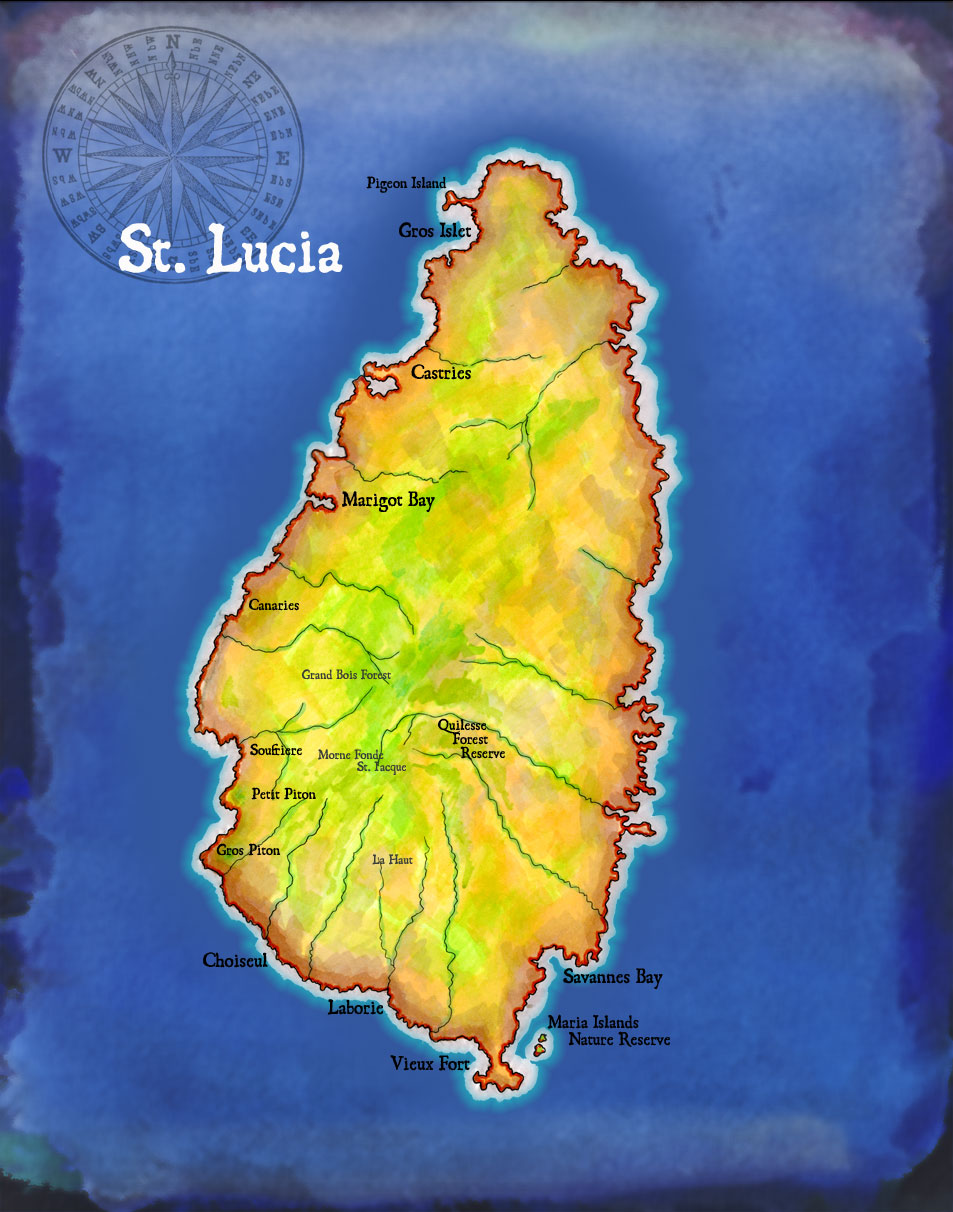
Our 757 took off from Atlanta, the world’s busiest airport, on a sub-freezing January morning. We would soon be landing at a notably quiet runway, and into the endless tropical summer. My girlfriend and I were taking a vacation to the tiny island nation of St. Lucia. This would be my first time in the Caribbean, the first time staying at an “all-inclusive” resort, and I was eager for the experience. We had flown over Puerto Rico a half hour earlier and were already settled into our gradual descent. French Martinique was green and beautiful below. Then St. Lucia appeared. Our flight path was taking us right over the island – northwest to southeast. We were lower now and I had a good view of the island, so modest in size that I could almost take it all in: the semi-dense development in the northwest; a three-masted sailboat in the cove of Pigeon Island; a cruise ship nestled into Castries’ (the capital) small harbor; bright blue water and light sand along the Caribbean coast; the green, lush, empty, rugged interior; a fleeting glimpse of the strange, picturesque, and famous pyramids of the Pitons in the southeast; and finally our figure-eight descent into Hewanorra International Airport at the south end of the island.

St. Lucia
St. Lucia is a dot in the ocean. It is one of the many Windward Islands of the Lesser Antilles, and lies smack in the path of the easterly trade winds. If you’ve never experienced the trade winds, as I hadn’t until I stepped off the plane onto the Hewanorra tarmac, imagine a 15 mph breeze – that never stops; a giant planet fan stuck in the on position. It’s no wonder sailors of old used these winds to cross the Atlantic. The island is just 258 square miles, just a tad larger than Chicago, and is home to a little more than 170,000 people. There are only 17 countries smaller in size and only 18 with fewer people (in both cases many of those smaller, less populated countries are fellow Caribbean islands). The country has a colorful history after European settlement in the mid-seventeenth century, changing hands between the British and French fourteen times (seven each), until the British established firm control following Napoleon’s first abdication and exile. The island remained under the Union Jack until gaining late independence from the disintegrating British Empire in 1979. That makes the country just a little older than me, and it remains in the Commonwealth of Nations. Upon viewing the Queen’s face [1] on the East Caribbean dollar – the official currency of St. Lucia and surrounding countries – I said to a local: “I see the Queen is still on your currency,” in a casual effort to gauge the local attitude towards their former rulers. I received a matter-of-fact explanation that the country was part of the Commonwealth, which didn’t tell me much.

The aboriginal population was decimated after contact with Europeans, and African slaves were imported in large numbers to work the island’s numerous plantations. Today the population is almost entirely black. English is the official language, but a French-Creole is the local vernacular. From observation, the locals speak English to tourists and Creole amongst themselves (more on this later).

The island is also obviously poor. The per capita income is less than $6,000 a year, a meager sum. Contrast that to Barbados a hundred miles to the southeast, a nation of similar size but with personal income four times larger. The dearth of wealth was obvious from the bland, functional airport and the languishing buildings on the way to our resort, a drive which fortunately took all of about three minutes because our resort, Coconut Bay Beach Resort (hereafter known as Coconuts), has the terrific convenience of being literally within sight of the main runway.

All-Inclusive
Coconuts from above
Coconuts is situated on a large plot along the Atlantic Ocean, maybe 100 acres in total, at the southwest corner of the island. According to our inbound flight attendants, it was a former Club Med and also the preferred layover hotel for pilots and flight crew (no doubt because of its proximity to the airport). It’s both the only resort on the Atlantic – windward – side of the island, and the only resort situated in the far south. This means the surf is constantly choppy and the water has a distinctly teal color, no clear turquoise to be seen. We were greeted with a glass of champagne, settled in our room, and took a walk around. The resort is comprised of two wings, one for families and one for couples (which is where we were staying), all with ocean view rooms. It includes half a dozen bars spread out over the complex [2], a main dining area, three specialty restaurants, a night club, main stage for nightly entertainment [3], at four sprawling pools, a small waterpark, tennis courts, and a tiny paintball battlefield. There was also a reception building and seaside gazebo (where a wedding occurred during our stay). Of course you can’t overlook the mile or so of breezy beachfront and fields of palm trees. In general, the buildings are older but they were well maintained and the rooms and common areas were clean, so I was happy. The large high ceiling-ed lobby was the first floor of the main central building, and it was open on the entrance and pool/ocean side to the elements. No need for walls and windows in a perfect climate. There was an “adults only” section with a private pool, bar, and beach, which my girlfriend and I planned to take full advantage of. Is this similar to countless other Caribbean resorts? Perhaps, but it nicely met my expectations.


Thursday, December 29, 2011

The Best Songs from 2011

by Conroy

With only days left in 2011, it's time for my annual Top 10 Songs list. As with the previous versions (see my 2010 list here), this list will count down what I consider to be the ten best songs from this year. As a reminder, there are a couple of ground rules for songs to be eligible for the list:
  • If at all possible, I try to include only one song per artist. For instance, I could have included multiple songs from the excellent album The King is Dead by The Decemberists, but adhering to my rule, and because I wasn't completely blown away by numerous album tracks, I've included just one song from the album. However, if we turned back time and I was writing about my Top 10 songs from say 1997, I would have included multiple songs from Radiohead's spectacular album OK Computer (after all, four songs from that album are included in my Top 250 Songs).   
  • All songs must be released in this calendar year (i.e. 2011). For instance, Adele released her massive hit album, 21, this year. The lead single "Rolling in the Deep" was a global hit, and it has made (often topped) critics’ Top 10 lists for 2011, but it was actually released and gained immediate airplay in 2010. Since it was released separate from the rest of the album and gained widespread attention, I must disqualify it from consideration for songs from 2011. Is this unnecessarily hair-splitting? Maybe, but I dislike recognizing songs more than a year after they become hits (or in the case of many great songs that don’t become hits, after their initial release). 
Also, as you read through this list I offer my familiar caution. As with all annual lists, my Top 10 Songs is based on impressions from this year with only a limited amount of time to have heard and internalized each of these songs. Often it takes years or more for the significance of a song, album, or any other artistic creation to become clear. I publish these lists because I think it's fun, generates discussion, and identifies some of the outstanding songs from the past year. However, it could be that I look back years from now with different opinions of what really was best from 2011 (consider my 2010 list to judge my judgment).  

Okay that's enough background, the list:

Conroy's Top 10 Songs of 2011

10. “Change the Sheets” by Kathleen Edwards. It’s been a few years since Kathleen Edwards’ previous release, the outstanding Asking for Flowers, but her follow-up Voyageur will be released early next year. If the whole album matches the quality of the lead single “Change the Sheets,” her fans will be much pleased. I especially like the multi-layered backing vocals that add a depth I haven’t heard from her before. The overall atmospherics of the track mix well with the personality that makes Kathleen Edwards’ music so appealing.

9. “Pill” by Edie Brickell. Edie Brickell has been around for a long time. She first hit it big with “What I Am" way back in 1988. So it was both surprising and exciting to hear her back this year with a self-titled album. “Pill” is a great example of ”happy” music – light, peppy, propulsive – that is about a dark subject, here depression. Some lyrics: “You can’t pay attention / It’ getting pretty rough / You feel a little down now / And you can’t get it up / They got a pill for that…” I like this type of juxtaposition of music and theme, but most of all, “Pill” is the type of song that can be listened to on a loop. I hope we don’t have to wait another eight years for the next Edie Brickell release.

8. “My Body” by Young the Giant. My sister turned me onto Young the Giant, and I’ve heard there debut album described as a mix of Fleet Foxes and Kings of Leon. Maybe, but I always find those types of descriptions unhelpful. What “My Body” features is a fantastic guitar-powered chorus, as good as anything released this year. Rock critics (and to a lesser extent fans) seem to have a longstanding angst that the genre is one day going to run out of steam. That a point will be reached when nothing new or interesting will come along. Given that the Rock n Roll has been popular and artistically inventive for over half a century, I find this point of view silly; no worry needs to be given to the fate of rock. Young the Giant is evidence that rock continues to be home to new, vibrant, and interesting music.


Monday, December 26, 2011

The Villages: A New Way to Retire

by Conroy

I looked out through the large bus windows at the rolling central Florida hills. The late morning sunlight was muted by the tinted glass, and the countryside appeared as a contrast of straw-colored grass and subtropical evergreen. It had been a drought-stricken winter, the end of the dry season, and even the dark murky lakes and ponds that dotted the landscape looked drained and shrunken. The bus was heading north from Orlando on the Florida Turnpike. In years past this ground was cultivated with orange groves, but too frequent winter frosts and freezes drove the orange growers south. Now ranching dominates and open, empty fields carry on along the rolling ground as far as the eye can follow . This part of the Sunshine State seems far removed from the palm-laden glitz and built-up densities of Miami and “South Florida,” or certainly the sprawling fantasy production of Disney World and the rest of Orlando’s tourist-entertainment parks. But it’s in this quiet corner of Florida where you will find one of the fastest growing communities in the United States, The Villages. That’s where my charter bus, one of many on the daily round-trip shuttle service to and from Orlando, was taking me.

The Villages is the brainchild of developer H. Gary Morse, who in the mid-1980s saw an opportunity to transform a struggling trailer park into a vast new development. Florida has long been famous as a Mecca for retirees, the “snowbirds” looking to escape the frigid winters of the Northeast and Midwest, and Morse carried this reality to a new conclusion: He wouldn’t build a retirement center, or neighborhood, but an entire town. Large tracks of northeast Sumter County (and smaller portions of adjacent Marion and Lake Counties) were bought, and over the last two plus decades, transformed into a new, wildly successful community. The population of The Villages, including part-time residents, is over 80,000 with a planned ultimate population of more than 100,000. With vast numbers of baby-boomers starting to retire, the U.S. might see a proliferation in these types of master-planned retirement towns, and I wanted to get a firsthand look at this potential future.

Entering The Villages
My bus, which I was glad was well less than half full, exited the Turnpike onto US 301. There followed a slow ten minute ride, which went through the sad-looking town of Wildwood. We passed tiny dilapidated bungalows, tired storefronts, and that general haphazard, disorderly look of neglected landscaping and forgotten maintenance. The impression is unmistakably one of the languishing rural South. What a contrast when a few minutes later and couple miles down the road we turned onto Buena Vista Boulevard and entered The Villages. We passed thousands of trim bright new houses. The white and cream facades accented with a mix of shingled gray, brown, and burnt orange roofs. Many houses feature patios and pools (all enclosed by lanai). We drove past several bright green golf courses; there are nearly 40 in the town all told, including nine 18- or 27-hole country club courses. There was also the exquisitely manicured landscaping: Large oak trees adorned with Spanish moss; palmettos lining golf courses; bushes shielding roadside houses; blooming flowers of pink, red, yellow, violet, and indigo brightening the roadside; and the thick, uniformly trimmed and edged carpet of grass. It was all wonderfully arranged and effectively used to delineate neighborhoods and break-up the views. Intersections occurred at roundabouts, not a traffic signal to be seen. Buena Vista Boulevard, like all major roads in The Villages, is flanked by paved cart paths. Perhaps the most distinctive feature of the town is the ubiquitous use of golf carts to get around – everywhere a resident would want to go – and today, Saturday, the carts were out in force.

Lake Sumter Landing
The bus stopped in Lake Sumter Landing, one of two town centers, which features several streets of pastel colored shops and restaurants radiating from a central square. I stepped off the bus into the sunny warm April day and was greeted by my hosts – my parents, part-time residents. The architecture and layout is all set-up following that Florida specialty, the theme, this being the Old South (e.g. a wooden bridge over a small canal, complete with a fake lock and waterwheel). The adjacent square (surrounded by buildings with a southern town façade) was busy as residents and their guests (like me) surveyed the offerings of local vendors; art and personal accessories mostly, and a regular daytime activity. The north side of the square is open and leads to Lake Sumter, right in the center of The Villages. The lake is fronted by houses on either side of the town center. This is apparently some of the choicest and priciest real estate in the whole town.

We walked to a close-by restaurant for lunch and the sidewalks and stores were no less busy. I was somewhat surprised by the composition of the crowds. While there was a surfeit of older people, there were also a lot of families. I had in mind a scene of senescent retirees, slow moving, quiescent. But the hustle I encountered was just like your local outdoor mall, not the exhausted idleness of a retirement home. I was skeptical when my parents told me they were buying a house in The Villages. I feared they were adopting a mentality and lifestyle older than their years. But on first exposure, my fears were somewhat allayed. There was vibrancy here, not certainly for a young person, but at least I could sense the appeal.

Saturday, December 17, 2011

Whose Money?

by Conroy

1 World Trade Center under construction
Drivers approaching lower Manhattan in 2011 have seen the steady rise of a new skyscraper, 1 World Trade Center. By December its steel superstructure already stood over 1,100 feet above street level, dominating the famous skyline around it. When the building is “topped out” next year it will be the tallest building in the United States (in fact the tallest in the entire western hemisphere).  1 World Trade Center is the most spectacular part of the massive World Trade Center redevelopment effort, which includes several other towers, the National September 11 Memorial & Museum (the memorial is open but the museum is still under construction), and a soon-to-be-completed transportation hub (road/rail/bus terminal). These are just some of the tangible signs that after a decade New York City has largely (physically) recovered from the 9/11 attacks.

Drivers Sue the World Trade Center?
Not long after 1 World Trade Center peeked above the surrounding buildings, the American Automobile Association (AAA), a service and advocacy group for over 50 million drivers, sued the Port Authority of New York and New Jersey (PANYNJ). Why? Well this fall PANYNJ announced significant toll increases, up to 50%, on its many New York area bridges and tunnels, which include the heavily trafficked Lincoln and Holland tunnels and George Washington Bridge. The higher tolls were needed, according to PANYNJ, to pay for ongoing facility maintenance and planned improvements and to cover some of the cost of the World Trade Center construction. You see, in addition to bridges, tunnel, airports, seaports, and transit, PANYNJ also owns several commercial properties the most visible being the World trade Center site. The AAA lawsuit claimed that the PANYNJ toll increases were an unfair burden to drivers and that toll revenues would be diverted from the bridges and tunnels that toll payers use to unrelated commercial enterprises. In other words, and rather nefariously in AAA’s eyes, 1 World Trade Center was rising high above Manhattan on the dime of drivers who would never benefit from the development.

PANYNJ has countered that in fact they misspoke and all of the revenue raised from increased tolls will be used on their transportation facilities and not a nickel to pay for the World Trade Center construction. Both sides argued their case in court last week and a ruling on the issue might be made by the end of the year. In light of PANYNJ’s modified account of how the toll revenues will be used, I foresee the new toll rates being upheld and no refunds for any AAA drivers, but I’m not a lawyer and won’t wager on any particular outcome.

This whole case may seem like one advocacy group attacking one issue from one public agency, but I think it’s a microcosm of a larger debate being held in many forms nationwide. Namely, when it comes to public money, whether it’s tolls or taxes, whose money is it and who gets to decide how it will be spent? In the 2010 U.S. midterm elections, Republicans across the country benefited greatly from a broad grassroots effort, the Tea Party movement, which essentially argued that elected officials and public agencies were incapable of responsibly using tax dollars. And therefore, all tax increases were unacceptable and major spending programs dubious. On the national level we’ve seen the results of last year’s elections: A tooth-and-nail struggle to get any spending programs passed through Congress, and none of those that eventually were passed included any tax increases. Clearly one’s sympathy or antipathy to the Tea Party movement’s agenda rests in your political and fiscal perspective, but this is one of the fundamental arguments in America today.

Whose Money is It?
So going back to the core question, whose money is it and who has the right to decide how it is spent?

Saturday, December 10, 2011

Dwindling Ranks

by Conroy

American ground crew like GMGF Jim
Just this past week America marked the 70th anniversary of the Japanese attack on Pearl Harbor; seventy years, a lifetime ago. This weekend my girlfriend’s maternal grandfather, Jim (hereafter referred to as GMGF Jim), will celebrate his 92nd birthday. These two occasions, the first a date of great historical significance, are separated by only a handful of days, and connected by the passing years.

The attack on Pearl Harbor plunged the United States into World War II. Americans responded by throwing themselves into the war effort, including millions of servicemen destined for all parts of the globe, in what would be the most impressive display of military force in history [1]. One of those men was a young GMGF Jim, in his early 20s, who enlisted in the U.S. Army, and was assigned to the new United States Army Air Force (USAAF), the predecessor of the modern USAF. When I met GMGF Jim in the middle of last year I was curious to hear more about his service, having learned only snippets from my girlfriend. Unfortunately, his advancing age has robbed him of most of his hearing, which means that conversations with him proceed in bursts of short shouted questions, often repeated, and followed by equally short shouted replies. All of this leads to a rather halting dialogue frequently waylaid by misunderstandings, incomplete details, and the basic ineffectiveness that disjointed rhythm has on communication. I would relate it to a phone call where there’s a long delay and you constantly have false starts, long pauses, and overlapping talking. It just doesn’t work well.

Two Experiences
I tell you this as a preface to what I’ve gathered of GMGF Jim’s war service; I think I have the broad elements correct, but the details may be iffy. He set sail from wherever basic training was, maybe his home of Baltimore, destined for Panama City, Florida. But due to some sort of mix-up, the ship instead went 1,500 miles too far south, to Panama…the country…in Central America. I know what you’re thinking: That can’t be right? Which was pretty much my reaction, but I pressed the point with GMGF Jim a couple of times and received that same answer (all I could do was shake my head and say “okay”). So, once in Panama, the local American military commanders had to do something with a ship full of recruits. Fortunately, there was a rather important strategic asset in the area, the Panama Canal. The Canal needed guarding and part of that duty fell to the USAAF. After a short stay on land, GMGF Jim and his fellow shipmates were sent through the Canal and sailed southwest to the Galapagos Islands [2]. There the USAAF established abase at Baltra Island. Planes from this base patrolled for enemy submarines and protected Allied (and neutral) shipping on the western approaches to the Canal. GMGF Jim spent the rest of the war as a member of the ground crew servicing planes.

Given the general danger of being in the military during World War II, I consider getting stationed in Darwin’s quiet balmy islands to have been a pretty plum assignment. Not bad considering it was a mistake. But it was work and it was far from home. Most of war is extended boredom and I’m sure GMGF Jim had moments of the tropical doldrums. Still, it’s an interesting story, and raises a few questions: He really ended up in Panama instead of Florida? The vast American military-logistic system was capable of misplacing an entire ship? There were on-site ad hoc solutions that ended up lasting the entire war? Whatever happened in Panama City when his ship didn’t arrive? What about the men originally slotted for Baltra Island, where they there as well? It all strikes me as a semi-comical combination of Catch-22 and Guard of Honor [3]. It’s also something I was never likely to learn without hearing it from the mouth of the man who lived it.

My maternal grandfather, Jack, also served in World War II as an artilleryman in Europe. He died fifteen years ago at the age of 79. In the last six years of his life his mind was decimated by Alzheimer’s, but even late in his life, long after most of his recent memories were lost, he was still able to tell me of his time in Europe. His service was more typical of what we think of as the American experience, war in Europe, fighting Germans through France, etc., though I gathered from him that he didn’t have any close calls on the battlefield.


Monday, December 5, 2011

The Shopping Season

by Conroy

Tis the -- shopping -- season
We’re in early December and for Americans that means we’re smack in the middle of the holiday season. It also means we’re in the full register-ka-ching-ing focus of the shopping season. Indeed if you were to list the most obvious manifestations of approaching Christmas [1] you would probably include the tiny many-colored glowing lights adorning neighborhood houses, or the Christmas trees and other seasonally related decorations inside the homes of you, your family, and friends [2], but also the inescapable, omnipresent, overwhelming seasonal advertising.

From the radio spots you suffer through when driving to work in the morning, the bright, glossy ads in newspapers and magazines, the loud television commercials, annoying internet popups, and in-your-face billboards…it’s everywhere. It’s Christmastime, and it’s time to shop. Best Buy, Walmart, and Target have, as usual, put out their heavy dosage of ads, but all major retailers are in on the game. I’m especially confounded by those ridiculous "December to Remember" Lexus commercials aimed at whatever infinitesimal fraction of the population chooses to buy luxury cars for Christmas [3]. And I guess it’s working, given the record sales on the super-hyped Black Friday and Cyber Monday shopping days. And surely many people, like my mom and aunts, really enjoy shopping; zeroing in on sales, mingling with the crowds, and wrapping gifts [4]. Why else would hordes of people stay up through the night of Thanksgiving jostling with other midnight shoppers? It can’t be just for the money-saving sales.

This year I’ve been struck by the tone of the advertisements, almost as if it’s your duty to shop, something along the lines of voting or obeying traffic laws. If you don’t participate, then it’s somehow antisocial and un-American. If you’re like me, you probably find this commercialization of Christmas unsettling in a somewhat-hard-to-define way. I’m not religious, but I was raised Catholic and went to Catholic school, and so, of course, it’s still worth noting that Christmas is a religious holiday, deeply special to Christians because it marks the birth of Jesus. In its evolved modern context, the holiday has wider significance than its religious foundations. It’s a time of celebration of the year completed, a time to spend with family a friends, and yes, even a time of giving. It’s this aspect of Christmas, the time spent with family and friends, that makes the Christmas season meaningful to me, and I’m guessing (or hoping), it is the largest reason Christmas is “the most wonderful time of the year” for most of you as well.

A part of what unsettles me about the commercial side of Christmas is the often cited fact that the holiday retail season is an essential feature of the consumer-driven American economy. You’ve probably heard the misleading statistic that two-thirds of the U.S. gross domestic product is derived from consumption – people buying things, but regardless of the real value, shopping is a major part of the modern economy. And about 20% of all retail sales come during the Christmas shopping season (November to December). This explains why businesses are so forceful with Christmas ads – they must make their money before the end of the year, or risk red-ink and failure. (I may be off base, but it seems a little alarming that a major prop of the world’s largest economy is the buying of Christmas gifts.) That’s also why we’re subjected annually to the phenomenon that Gregg Easterbrook has termed “Christmas Creep”: Seasonal advertisements appearing ever earlier in the year. Now it’s common to come across Christmas-themed store displays and print advertisements before Halloween, sometimes well before. How long before Christmas advertisements start in the summer? It sucks a lot of the specialness out of the season when Christmas is exploited throughout the non-Christmas-time of the year.

Gifts under the Christmas tree
But that’s an external issue. What really bothers me the most is the expectations that come along with gift-giving. I’m an embodiment of the cliché that it is better to give than receive. When I was a child I loved to get gifts, and I was fortunate that my parents and other relatives lavished me and my brother and sister with a lot of them. But now with maturity, I much prefer giving gifts to my family (girlfriend included), especially when I know they can use or want what I’ve gotten for them. It’s a rewarding feeling and genuinely selfless, I give for the enjoyment of others and not for my own satisfaction of giving (although I guess I can’t deny the presence of some selfish gratification I get from being perceived as generous and thoughtful). But unfortunately, too often gift giving is not a bonus of Christmas but a requirement, a burden.


Sunday, November 27, 2011

End of the Season

by Conroy

Roger Federer with his 70th winner's trophy
The 2011 ATP season is over [1], and it ended just like last year. Roger Federer dominated the late fall, winning his final seventeen matches, the last seven of which were against Top 10 ranked opponents (which might be a record), and capturing his record sixth ATP World Tour Finals [2] title. In the process, he demolished Rafael Nadal in his most lopsided victory against the Spaniard and further cemented his claim as the greatest player of all time.

But the end wasn’t at all what the 2011 tennis season was about. Looking back from the finish, it’s clear that the climax occurred two-and-a-half months ago in New York.

US Open Final
Arthur Ashe Stadium
Late on a Monday afternoon [3] in early September Novak Djokovic and Rafael Nadal, the world’s two best tennis players, took the court at Arthur Ashe stadium to contest the U.S. Open Final. It was a rematch of the 2010 Final, but this year Djokovic was the top seed, winning his way match-by-match through a near-perfect season. Nadal was a definite underdog. As they began their warm-up, the sinking sun already cast long shadows across the blue court and its expansive green penumbra. The capacity New York crowd of 25,000, the largest audience in tennis, buzzed in anticipation.

Djokovic had dominated the first eight months of the year. Heading into the U.S. Open Final he had remarkably won 63 of his 65 matches, nine titles, including the Australian Open and Wimbledon, and dominated Nadal, beating him in all five of their meetings (all in finals). By what seemed a minor miracle, and confirmation that he was in the midst of a historic year, he escaped near-certain defeat in the semi-finals against Roger Federer (click here to see one of the gutsiest and fearless shots you’re ever likely to witness). He looked destined to win the U.S. Open and consolidate the top ranking he had taken from Nadal at Wimbledon. For his part, Nadal was looking to reclaim some of his palpably diminished aura and end his losing streak to Djokovic. In the process claiming his second grand slam title of the year [4], and perhaps steal the number 1 ranking back by the end of the season.

Speaking as a tennis fan, the match was mesmerizing; an apotheosis of power-baseline tennis. Both men played at their peak, as good I think, as they could have played on that surface and that day in front of a huge expectant crowd and millions of television viewers. They are the two best defenders in tennis and probably the two most consistent baseline ball-strikers. Those skills resulted in point after point of long rallies, of sustained sprinting to all corners of the court, and of pure power hitting. Both men repeatedly retrieved what appeared to be sure winners from the other; points ending with each man’s legs and lungs burning. From a purely physical perspective it may have been the most brutal tennis match ever played (see some of the highlights here). By the end Djokovic was suffering from a back injury and the normally indefatigable Nadal appeared totally enervated, his body (and maybe his mind) unable to compete any longer. What else was obvious is that point-by-point Djokovic was better. It seemed that he returned every Nadal serve back at the Spainard’s feet. He won the majority of the long rallies. He won the important points.

An exhausted Djokovic after his U.S. Open win
Djokovic took the first two sets despite early leads in each by Nadal. With day fading into night and the stadium lights taking over, Nadal came back and won the long, intense, captivating third set. After the first game of the fourth set, Djokovic, who just a few minutes earlier was serving for the championship, took a medical timeout for a lower back injury. For a moment it appeared that a monumental comeback was in store. But it didn’t happen, Djokovic regrouped and Nadal was spent. After a little more than four hours [5] and four unforgiving sets the Serb stood as champion. To borrow a boxing analogy, he took the best punches that Nadal could throw and returned his own with interest. He fulfilled the promise of his season-long success. He was the best.

Post U.S. Open
A tired Djokovic at the World Tour Finals
And then, after that scintillating victory, the air was let out of the balloon. Djokovic played just ten more matches, going a very average 6-4 over the remainder of the season. At least two, but maybe all four of those losses were at least partially the result of a bad back or aching right shoulder. And after his mild exit from the World Tour Finals, Djokovic admitted that he was physically and mentally drained. The season, and all his success, had taken a toll. He needed time to recuperate.  Nadal went just 8-4 after the U.S. Open (and just 2-4 over his last six matches), including very lopsided losses to Federer and Andy Murray [6].

The post-U.S. Open fall season often plays like a quiet denouement to the rest of the year. And given how meekly Djokovic and Nadal played, the two bright lights of the season through the U.S. Open, it seemed especially so this year. But there is more to be gleaned from the late season results.


Monday, November 21, 2011

Political Failure

by Conroy

I’ve never used this blog as a place to write about political issues or rail against political developments. As far as possible, I like to maintain an apolitical tone, out of respect to readers and because my deep-seated pragmatism guides me to a more centrist perspective. But the events of today require a response.

The much hyped Congressional “Super Committee” (officially named the United States Congress Joint Select Committee on Deficit Reduction) of six Democrats and Republicans has failed in its one and only task of identifying at least $1.2 trillion in federal budget cuts (spread out over ten years).

As you may recall, back in the summer there was a debt-ceiling crisis – entirely of the political class’ doing – when the United States nearly reached its debt (borrowing) limit. The crisis was precipitated when Congressional Republicans refused to extend the government’s borrowing limits without a guarantee of commensurate reductions in spending (anathema to Democrats). For their side, Democrats refused to consider spending cuts without some form of tax increases (anathema to Republicans). Neither side budged and the prospect of a limited government default was at hand. At the eleventh hour a compromise deal, endorsed by President Obama and House Speaker John Boehner, was passed by Congress. It raised the federal borrowing limit but required substantial cuts in government spending. Those cuts were to be identified by the Super Committee. There were to be no new taxes.

Following all this haggling Standard & Poor's actually downgraded the United States credit rating for the first time in the nation’s history, and the stock market plummeted by several hundred points (several percent of its total). It was a stark indictment of the men and women controlling America’s federal finances.

The national debt has been an issue for a long time, but it has really soared over the last decade as increased defense spending and rapidly increasing Social Security and health care costs, combined with two large tax cuts and a major recession to throw the federal budget out of whack. Despite non-stop talk in Washington about corralling the ballooning debt, nothing was done. That was supposed to end with the latest budget bill.  

Politics without Leadership
Now, nearly four months later, despite all of the promises and hoopla surrounding the Super Committee, and after ten weeks of in camera meetings, no schedule of spending cuts has been identified. Congress (and the President) has failed to lead; to make tough choices. Instead, as this summer’s budget bill stipulates, automatic cuts will be enforced starting in 2013. These include 8-9% reductions in both defense and non-defense programs. However, third rail programs like Social Security will not be touched.

No doubt in the immediate term – like tomorrow – we will see another drastic decline in the stock market as investors react to yet more government ineptitude.

This abdication of responsibility allows Republicans to go back the their constituencies and boast about avoiding tax increases and Democrats to go back to their constituencies and brag about maintaining vital social programs. And here’s the kicker: Between now and 2013, Congress has the power to exempt programs from the automatic cuts. It’s very possible that by the time 2013 comes around special interests will have lobbied Congress out of all serious cuts. In other words, nothing will be cut. Business as usual; and the national debt will continue to pile up at record levels. The President held a short press conference this afternoon where he promised to veto any bill that exempts programs from the automatic cuts. Sound words, but we’ll see.


Tuesday, November 15, 2011

Getting Old

by Conroy

Jeanne Calment - the oldest person on record (122 yrs.)
What if we never had to get old? A couple of days ago I kept encountering this theme. First, there was a minor headline on the cover of this past week’s edition of The Economist that hinted at an answer to this most captivating of questions. I was immediately intrigued and excitedly flipped through the magazine to find the article. My mind was alive with thoughts of about staying forever young, about immortality. Alas, and not surprisingly despite my silly reaction, the article related emerging science that promised considerably less.

Read the article for the specific details, but experiments in mice have shown that counteracting certain genes in cells that have reached their biological age limit can check some of the deterioration associated with aging. Someday, it is hoped, these types of approaches could be used to ease the effects of senescence in humans. I hope, for not entirely selfish reasons, someday comes sooner rather than later.

Then, by sheer coincidence, I was re-reading a portion of James Joyce’s Ulysses – searching for a remembered (different) passage – when I rediscovered the following paragraphs (it’s a longish excerpt, but worth it [1]):

What spectacle confronted them when they, from the host, then the guest, emerged silently, doubly dark, from obscurity by passage from the rere of the house into the penumbra of the garden?

The heaventree of stars hung with humid nightblue fruit. [2]

With what meditations did Bloom accompany his demonstration to his companion of various constellations?
Meditations of evolution increasingly vaster: of the moon invisible in incipent lunation, approaching perigee: of the infinite lattiginous scintillating uncondensed milky way, discernible by daylight by an observer placed at the lower end of a cylindrical vertical shaft 5000 ft deep sunk from the surface towards the centre of the earth: of Sirius (alpha in Canis Major) 10 lightyears (57,000,000,000,000 miles) distant and in volume 900 times the dimension of our planet: of Arcturus: of the precession of equinoxes: of Orion with belt and sextuple sun theta and nebula in which 100 of our solar systems could be contained: of moribund and of nascent new stars such as Nova in 1901: of our system plunging towards the constellation of Hercules: of the parallax or parallactic drift of so called fixed stars, in reality evermoving from immeasurably remote eons to infinitely remote futures in comparison with which the years, threescore and ten, of allotted human life formed a parenthesis of infinitesimal brevity.

And then by further coincidence, I flipped on the television and caught the very end of Rocky III, where in a more succinct and less inflated way than Joyce, Apollo Creed [3] says to Rocky, in a fleeting reflective aside about the waning of his once overwhelming physical skills:

"You know Stallion?  It's too bad we gotta get old."
 
And so my mind settled on the sad fact of getting old and mortality. Happy thoughts, I know, but ones we’re all apt to brood over from time to time.

Senescence
I’m 31-years-old, and I still throb with the vigor of youth [4]. But in the coming years the signs of aging are going to appear. We all know these signs: decreasing speed, dexterity, and reaction time; graying hair; balding (for men); wrinkles; weight gain; loss of muscle mass and bone density; lower sex drive; flagging energy; arthritis; deteriorating vision and hearing; loss of collagen that makes your skin all droopy and inelastic; age spots; age-related illnesses like heart disease; memory loss, and maybe dementia. Just think of your grandparents. Nothing that you look forward to, all things you want to delay as long as possible. It’s not a pretty picture. Just compare the following two photographs.

 Robert Redford in his early 30s


 Robert Redford in his mid-70s


(Of course I’m planning (read: hoping) to age well, like Paul Newman or Cary Grant. No one has actually laughed when I’ve suggested this, which is nice of them.)

And then somewhere along the arc of aging, we die. Aging and death are cruel facts, especially for intelligent life. It’s cruel that humans can witness our senescence and contemplate our physical demise. But, contemplation is the first step to understanding, which is where we stand; there are several theories about why we age: