Showing posts with label travel. Show all posts

Tuesday, August 28, 2012

Visiting Key West

by Conroy

A view along Duval Street
Key West. What comes into your mind when you read those words?

How about a sunny tropical island? Key West is the only American city never to record a frost. Its warm climate, flat geography, and native flora are closer to that of the Bahamian cays than to the rest of Florida (let alone the rest of the continental U.S.). Walking slowly down busy Duval Street under the fierce July afternoon sun and through the still humid air, sweat seeping from your face and torso, you realize that Key West, unlike any other place in the U.S. is truly tropical.

What about a quirky laidback end-of-the-line town? Some of the locals call it Key Weird and the city has a long reputation for openness; Cuban immigrants, homosexuals, those just looking for a place to forget the past to start over, not to mention the hordes of pleasure seeking tourists (to name but a few groups) have given the island its own distinctive come-as-you-are and do-as-you-please culture.

Or maybe, if you’re geographically inclined like me, you think of the southernmost city in the continental United States? Let’s start with that. For those who haven’t been, Key West is the last island in the long chain of the Florida Keys, the archipelago that stretches in a hundred mile arc west-southwest from the southern tip of the Florida peninsula. The Keys rise from the shallow turquoise waters of the Straits of Florida and range in size from small, flat, forested islands to tiny coral specs. Key West city occupies the small Key West Island, which is just five square miles, as well as a few neighboring islands to the immediate east and north.

It’s hard to fairly distill a place in a brief description, but perhaps one famous landmark will help. Take a look at the photo on the right. This is the famous concrete bell at the intersection of South and Whitehead Street that marks the southernmost point of the continental United States. This bell makes for a great photo op and what you can’t see is the lengthy queue of people that are usually lined up during the day to get their pictures. Let’s linger on this monument for moment, and consider the four separate messages contained in its 18 words. They tell us a whole lot about Key West, or about how Key West wants to viewed by the outside world.

SOUTHERNMOST POINT CONTINENTAL U.S.A.

This is by far and away the Key West’s most celebrated claim to fame. It is the southernmost city in the contiguous U.S. Quick quiz: can you name the eastern-, western-, or northernmost cities in the continental U.S.?1 Probably not, but you may know about Key West because residents have made the most of their geographic extreme, it’s part of Key West’s allure as an end point, the end of the road, mile zero, the furthest you can go. The thing is anybody who stands by this monument can see that it’s not actually located at the southernmost point on the island. The real southernmost point is just to the west on the U.S. Navy’s Truman Annex property where the general public can’t go. And this is a nice microcosm of Key West itself: almost the southernmost place. Key West is an island far from Florida’s mainland, so it really isn’t a part of the “continental” U.S. at all. I would suggest it’s more accurate to say that Key West is the southernmost point in “lower 48” states or even the contiguous U.S. Terminology aside, all of the uninhabited Dry Tortugas (islands that are also part of Florida) lie to the west and several to the south of Key West2. So technically, Key West isn’t the southernmost point in the “lower 48”. It’s just the southernmost point that’s easy to get to.

And of course, it’s worth noting that all (or just about all) of Hawaii is farther south than Key West, and for that matter so is Puerto Rico, the U.S. Virgin Islands, and almost all of America’s Pacific territories. Why am I harping on these technicalities? I mean who cares really?  It’s just this: the idea of Key West as the southernmost point in the U.S. – as a geographic extreme – is critical to the culture and atmosphere (and even the psychology) of the place. It doesn’t have to actually be the southernmost point, it just has to seem that way. Which leads to the next phrase.

90 MILES TO CUBA

Like the southernmost point, “90 miles to Cuba” is a well-worn phrase, and it’s more or less true (though in fact at the closest point Cuba is a little more than 90 miles to the south). Key West is significantly closer to Havana than to Miami3. And this phrase became commonplace during the Cold War and especially the Cuban Missile Crisis when Soviet nuclear weapons were being installed “90 miles” from the U.S. But what’s the big deal about this fact? I mean Bimini in the Bahamas is only 50 miles east of Miami. Monterrey, Mexico, and Toronto, Montreal, and Vancouver, Canada are all closer to the U.S. border. I think again, like the southernmost point, the idea that exotic Cuba is seemingly so close, just over the southern horizon, is important to the atmosphere of Key West: a place so distant and distinct from the rest of America that it’s like a foreign country.

And this may be hard to believe, but a few times as my girlfriend and I walked in the evening twilight, in and out of colorful shops, past raucous bars open to the street, under the darkening silhouettes of cruise ships that towered over dockside buildings, hearing many non-English voices, with the clinging, unrelenting heat, and wild palms trees and tropical vegetation overhanging the sidewalks, I did indeed feel, if only for a moment, that I was in some other country. A semi-America; not quite foreign, but disorienting and unfamiliar. Then something very American, like a loud pickup truck or the bright lights of a convenience store, would jolt me back. I was in America, Key West America, but America.


Saturday, January 14, 2012

A Short Trip to Paradise

by Conroy

Arriving
The famous Pitons
I gazed at the gibbous moon gleaming low in the afternoon sky. I was on a south-flying plane looking east over the cobalt Caribbean. From 38,000 feet the sea seems as static as a painting; the rippled surface, flecked by bright white wave crests, appears fixed like stone. The sporadic clouds cast a patchwork of dark size-less shadows onto the water. The daytime sky looks different from high altitude, the blue purer, the dome of the sky a darker azure than can ever be seen from the ground. When I travel by plane I always feel like my fellow passengers and I are nowhere, lost for a time between origin and destination. We’re not where we started or where we’re going. This perception is powerful during night flights, especially over water, where only blackness can be viewed from the windows. But it’s true during the day as well; flying high above the world, detached from the slow fade of the terrestrial reality far below. And it’s emphasized when the place left behind and the place traveled to are drastically different – as they were today.

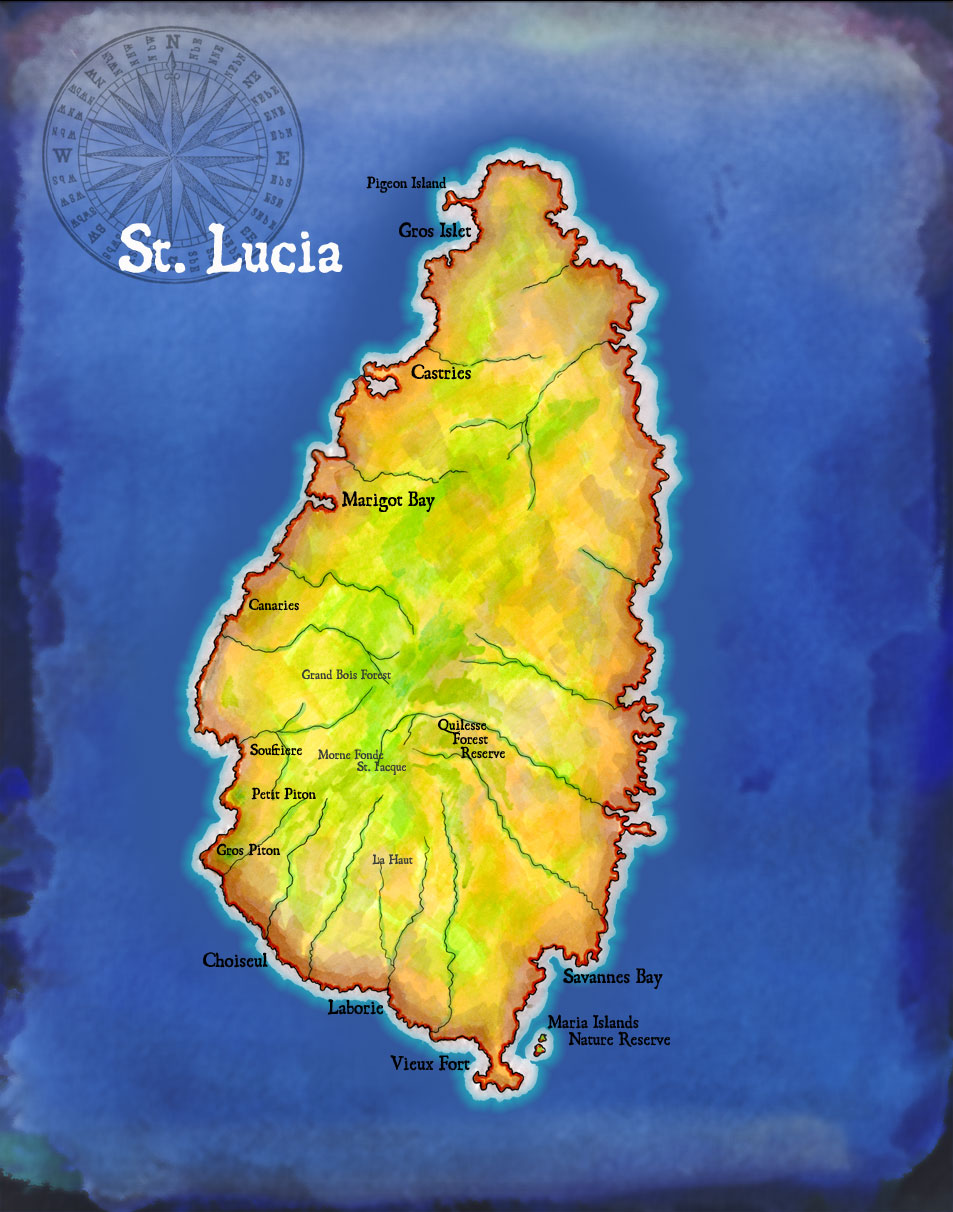
Our 757 took off from Atlanta, the world’s busiest airport, on a sub-freezing January morning. We would soon be landing at a notably quiet runway, and into the endless tropical summer. My girlfriend and I were taking a vacation to the tiny island nation of St. Lucia. This would be my first time in the Caribbean, the first time staying at an “all-inclusive” resort, and I was eager for the experience. We had flown over Puerto Rico a half hour earlier and were already settled into our gradual descent. French Martinique was green and beautiful below. Then St. Lucia appeared. Our flight path was taking us right over the island – northwest to southeast. We were lower now and I had a good view of the island, so modest in size that I could almost take it all in: the semi-dense development in the northwest; a three-masted sailboat in the cove of Pigeon Island; a cruise ship nestled into Castries’ (the capital) small harbor; bright blue water and light sand along the Caribbean coast; the green, lush, empty, rugged interior; a fleeting glimpse of the strange, picturesque, and famous pyramids of the Pitons in the southeast; and finally our figure-eight descent into Hewanorra International Airport at the south end of the island.

St. Lucia
St. Lucia is a dot in the ocean. It is one of the many Windward Islands of the Lesser Antilles, and lies smack in the path of the easterly trade winds. If you’ve never experienced the trade winds, as I hadn’t until I stepped off the plane onto the Hewanorra tarmac, imagine a 15 mph breeze – that never stops; a giant planet fan stuck in the on position. It’s no wonder sailors of old used these winds to cross the Atlantic. The island is just 258 square miles, just a tad larger than Chicago, and is home to a little more than 170,000 people. There are only 17 countries smaller in size and only 18 with fewer people (in both cases many of those smaller, less populated countries are fellow Caribbean islands). The country has a colorful history after European settlement in the mid-seventeenth century, changing hands between the British and French fourteen times (seven each), until the British established firm control following Napoleon’s first abdication and exile. The island remained under the Union Jack until gaining late independence from the disintegrating British Empire in 1979. That makes the country just a little older than me, and it remains in the Commonwealth of Nations. Upon viewing the Queen’s face [1] on the East Caribbean dollar – the official currency of St. Lucia and surrounding countries – I said to a local: “I see the Queen is still on your currency,” in a casual effort to gauge the local attitude towards their former rulers. I received a matter-of-fact explanation that the country was part of the Commonwealth, which didn’t tell me much.

The aboriginal population was decimated after contact with Europeans, and African slaves were imported in large numbers to work the island’s numerous plantations. Today the population is almost entirely black. English is the official language, but a French-Creole is the local vernacular. From observation, the locals speak English to tourists and Creole amongst themselves (more on this later).

The island is also obviously poor. The per capita income is less than $6,000 a year, a meager sum. Contrast that to Barbados a hundred miles to the southeast, a nation of similar size but with personal income four times larger. The dearth of wealth was obvious from the bland, functional airport and the languishing buildings on the way to our resort, a drive which fortunately took all of about three minutes because our resort, Coconut Bay Beach Resort (hereafter known as Coconuts), has the terrific convenience of being literally within sight of the main runway.

All-Inclusive
Coconuts from above
Coconuts is situated on a large plot along the Atlantic Ocean, maybe 100 acres in total, at the southwest corner of the island. According to our inbound flight attendants, it was a former Club Med and also the preferred layover hotel for pilots and flight crew (no doubt because of its proximity to the airport). It’s both the only resort on the Atlantic – windward – side of the island, and the only resort situated in the far south. This means the surf is constantly choppy and the water has a distinctly teal color, no clear turquoise to be seen. We were greeted with a glass of champagne, settled in our room, and took a walk around. The resort is comprised of two wings, one for families and one for couples (which is where we were staying), all with ocean view rooms. It includes half a dozen bars spread out over the complex [2], a main dining area, three specialty restaurants, a night club, main stage for nightly entertainment [3], at four sprawling pools, a small waterpark, tennis courts, and a tiny paintball battlefield. There was also a reception building and seaside gazebo (where a wedding occurred during our stay). Of course you can’t overlook the mile or so of breezy beachfront and fields of palm trees. In general, the buildings are older but they were well maintained and the rooms and common areas were clean, so I was happy. The large high ceiling-ed lobby was the first floor of the main central building, and it was open on the entrance and pool/ocean side to the elements. No need for walls and windows in a perfect climate. There was an “adults only” section with a private pool, bar, and beach, which my girlfriend and I planned to take full advantage of. Is this similar to countless other Caribbean resorts? Perhaps, but it nicely met my expectations.


Monday, May 16, 2011

Where to Travel Next?

by Conroy

The breathtaking Amalfi Coast of Italy
With summer almost here, my girlfriend and I are discussing vacation options. In addition to a few near-by short-term trips already planned, we both want to go somewhere far away and new to us. That led me to thinking more constructively about all of the places that I want to go. I’ve thought about these vacations before, some many times, but never actually put them down in writing. And let’s be honest, with the breadth of places that I want to visit and the scope of some of the trips, it’s going to take a well-thought-through plan to make it happen. I’m not fortunate enough to have an unlimited travel budget or endless vacation days, so I have to be smart in prioritizing my list and combining destinations if possible. 


I’m sure this will be an evolving process, but the first step is to list where I want to go and what I want to see. Below is that list, with destinations grouped into potential one to two-week vacations. For completeness I’ve also listed the places that I’ve already visited. After all, you can’t know where to go next unless you understand where you’ve been. Also, the list is of places and not events. I’m sure it would be unique to say, go to the Tour de France, but I don’t think I’d travel for that purpose alone.

Travel and Adventure
A quick aside. I know many people who are indifferent to travel, or at least travel to distant or foreign destinations. Not me. I find the experience of big vacations to be a great adventure. Thinking about vacations is enjoyable, the planning and anticipation leading up to the trip even more fun, and actually going is great.

If you feel the same way, do you ever ask yourself why traveling is so exhilarating? I can give two reasons. First, the world is big and fascinating (I hope readers of this blog know this perspective of mine by now). I read so much in books, magazines, and other writings about the world’s histories and cultures. I see places and events in television, films, and photographs. This stimulates my interest. I want to take the next step and travel to what I read about and see in media; to be surrounded by a new place. On previous vacations I’ve found myself giddy with excitement when I first arrive, so eager to start exploring.

The Cobb at Lyme Regis with the Undercliff in the background
A good example: several years ago I vacationed in London but made a special point to take a side trip to Lyme Regis, a small town in Dorset on the English Channel coast. Why go there? Well it was the setting of one of my favorite novels, The French Lieutenant’s Woman, and home to book’s author, the great John Fowles. The book and writer drew me in; I wanted to see it for myself. I went to Fowles’ house – this was a year before his death – though he didn’t like visitors so I merely strolled by, walked out onto the Cobb that features prominently in the 1981 film adaptation, and meandered back in the Undercliff wooded preserve above the town where much of the critical action takes place. It was a very worthwhile and enjoyable trip and subsequent readings of the novel have been enhanced as a result.

The second reason, and harder to articulate, is what I term the places the haunt me. I use the term in the context of being captivated not scarred. For whatever reason, some places captured my imagination in a deep and visceral way when I was young. There’s more to this than just travel, and I’ll write broadly about what I mean in a future post, but a good example is Australia. Even since I was very young I wanted to go down under. I did in 2006, and Sydney, Uluru, the Great Barrier Reef, the landscapes, and people were all that I thought they would be.

Where are the places you would like to visit and why? What would you like to see and experience in person? What places “haunt” you?